ECONOMIC EMPOWERMENT · JOBS · SDG 8

Economic empowerment
challenges and opportunities

How we read the latest Stats SA Labour Force Survey, the ILO and South African government data, and how Big Five Group answers with Feed · Educate · Empower: owners, not only jobs, at the places people already pass every day.

External context only. Stats SA, ILO, AfDB and government figures are official statistics, not Big Five audited metrics. Each one is quoted as published, with its period and a link, and every source is listed at the end of the page. Group programme numbers use the labels on Methodology.

GROUP NORTH STAR

Feed. Educate. Empower.

Deploy skills, capital, platforms and relationships so Africa can feed its people, educate its leaders, and empower its enterprises — at scale and with proof. Our vision, “A prosperous Africa — for everyone on it”, needs communities that build economies they own.

HumanityInnovationIntegrityExcellenceImpact
STATS SA · QUARTERLY LABOUR FORCE SURVEY · Q3 2026

The jobs challenge we design against

The Quarterly Labour Force Survey is South Africa's official measure of work. The latest release covers July to September 2026. We use it as external context, then build enterprise where people live.

33.7%

official unemployment rate in South Africa (8.6 million people unemployed)

One in three South Africans who want work cannot find it

Employment rose by 101 000 in the quarter, but unemployment rose too, by 97 000. Year on year the rate is up 1.8 percentage points.

Stats SA · Quarterly Labour Force Survey P0211 (released 10 Nov 2026) · Q3 2026 (Jul–Sep)

63.6%

unemployment rate for South Africans aged 15–24

Young people carry the heaviest load

Almost two in three young people in the labour force aged 15–24 are unemployed. For 25–34 year-olds the rate is 41.4%.

Stats SA · Quarterly Labour Force Survey P0211 (released 10 Nov 2026) · Q3 2026 (Jul–Sep)

44.0%

combined rate of unemployment and the potential labour force (LU3), which counts discouraged job-seekers

The broader picture is larger still

The official rate counts only people who searched for work and could start. Adding the potential labour force, such as discouraged job-seekers who want work but have stopped searching, gives 44.0%.

Stats SA · Quarterly Labour Force Survey P0211 (released 10 Nov 2026) · Q3 2026 (Jul–Sep)

44.7%

of South Africans aged 15–34 were NEET: 9.384 million young people

A generation outside work and learning

More than four in ten South Africans aged 15–34 are not employed, studying or training. Every month outside both makes the way back harder.

Stats SA · Quarterly Labour Force Survey P0211 (released 10 Nov 2026) · Q3 2026 (Jul–Sep)

YOUTH · SOUTH AFRICA AND AFRICA

The younger you are, the harder it is to start

Unemployment falls with every age group, and with every level of education completed.

Official unemployment rate by age

South Africa, Q3 2026 (Jul–Sep), LU1

  • 15–2463.6%
  • 25–3441.4%
  • 35–4429.7%
  • 45–5421.0%
  • 55–6413.1%

Stats SA · Quarterly Labour Force Survey P0211 (released 10 Nov 2026) · Q3 2026 (Jul–Sep)

39.2%

unemployment rate for people without matric, against 11.9% for graduates

Stats SA · Quarterly Labour Force Survey P0211 (released 10 Nov 2026) · Q3 2026 (Jul–Sep)

21.6%

youth NEET rate in sub-Saharan Africa, just above the global average; nearly two-thirds of the global youth population increase now accrues to the subregion

ILO · Global Employment Trends for Youth 2026 · 2025

Skills and jobs are one journey. Our sister page on education follows South African learners from the early years to their first job.

Quality education
WOMEN'S ECONOMIC PARTICIPATION

Women are more likely to be shut out

Women in South Africa are less likely to be in the labour force, and more likely to be unemployed when they are.

54.9%

labour force participation rate for women, against 65.0% for men

Stats SA · Quarterly Labour Force Survey P0211 (released 10 Nov 2026) · Q3 2026 (Jul–Sep)

48.3%

of young women aged 15–34 were NEET, against 41.3% of young men

Stats SA · Quarterly Labour Force Survey P0211 (released 10 Nov 2026) · Q3 2026 (Jul–Sep)

INFORMAL ECONOMY · TOWNSHIP ENTERPRISE

Where most Africans already earn a living

Across Africa, most work is informal. In South Africa, nearly a quarter of people live in townships, where most enterprises start out of necessity.

83.1%

of all employment in Africa is informal (86.3% in sub-Saharan Africa; 89.5% for women in sub-Saharan Africa)

ILO · Overview of the informal economy in Africa (2025) · 2024, ILO modelled estimates

3.476 million

people employed in South Africa's informal sector (21st ICLS definition, not comparable with pre-Q3 2025 figures)

Stats SA · Quarterly Labour Force Survey P0211 (released 10 Nov 2026) · Q3 2026 (Jul–Sep)

19 million

jobs projected by end-2025 under the AfDB Jobs for Youth in Africa strategy, which mobilised over $105 billion

African Development Bank · Jobs for Youth in Africa (13 Oct 2025) · Strategy 2016–2025

UNITED NATIONS · SUSTAINABLE DEVELOPMENT GOALS

SDGs that frame our empowerment work

Decent Work sits at the centre. Poverty, inequality, education, hunger and partnerships decide whether work reaches the people who need it.

SDG 8: Decent Work and Economic Growth

Goal 8

Decent Work and Economic Growth

The challenge

Promote sustained, inclusive growth and decent work for all. In sub-Saharan Africa the youth NEET rate was 21.6% in 2025, and nearly nine in ten young workers in low- and lower-middle-income countries are in informal employment (ILO).

Source: ILO · Global Employment Trends for Youth 2026

How we respond

Container franchises owned and run by youth and women, jobs in production, packing and logistics, and supplier growth on SupplierAdvisor®.
SDG 1: No Poverty

Goal 1

No Poverty

The challenge

Joblessness and poverty reinforce each other. When households have no earner, food, school and health all suffer.

How we respond

Income at the last mile: a franchise owner's own outlet, stocked with affordable Big Five Foods™, where people already pass every day.

SDG 2: Zero Hunger

Goal 2

Zero Hunger

The challenge

Food is often the first thing a jobless household cuts. Affordable nutrition close to home protects children while adults look for work.

How we respond

Fortified Big Five Foods™ sold through the same containers that create the jobs, and feeding projects that count every meal.

SDG 17: Partnerships for the Goals

Goal 17

Partnerships for the Goals

The challenge

Government, business, funders and communities each hold part of the answer. Without shared rails, enterprise support stays small and hard to verify.

How we respond

Customer and partner projects in one system, verified trade on SupplierAdvisor®, and capital pathways through Big Five Access.

Official SDG colour tiles · sdgs.un.org/goals

OPPORTUNITIES

Where challenge becomes design space

The data points to what must be built: owners at the last mile, a formal backbone for informal enterprise, women at the centre, verified trade and capable leaders.

01

Franchises that create owners, not only jobs

A Big Five Direct container gives a young person or a woman their own business, with stock, training and a tested site.

02

Township retail with a formal backbone

Most township enterprises are informal. Reliable supply, simple records and fair terms help them grow without losing what works.

03

Women at the centre

Women's unemployment is higher and their participation lower. Outlets designed to be run by women close part of that gap directly.

04

Verified trade for small suppliers

SupplierAdvisor® lets small producers and suppliers show they can be trusted by schools, programmes and retailers.

05

Capital that reaches the last mile

Big Five Access and project funding connect funders to specific containers and projects, with progress they can follow.

06

Leaders who can run a business

The Super-Cube® model builds the self-leadership and people skills a franchise owner needs on day one.

BIG FIVE GROUP RESPONSE

How the Empower pillars answer the challenge

Last-mile rails, verified trade, capital, delivery discipline, corridors and community partnership, working with Feed and Educate as one system.

Big Five Direct
Mission · Empower
THE CHALLENGE

Youth and women need a way into work where they live, not only in city centres.

OUR RESPONSE

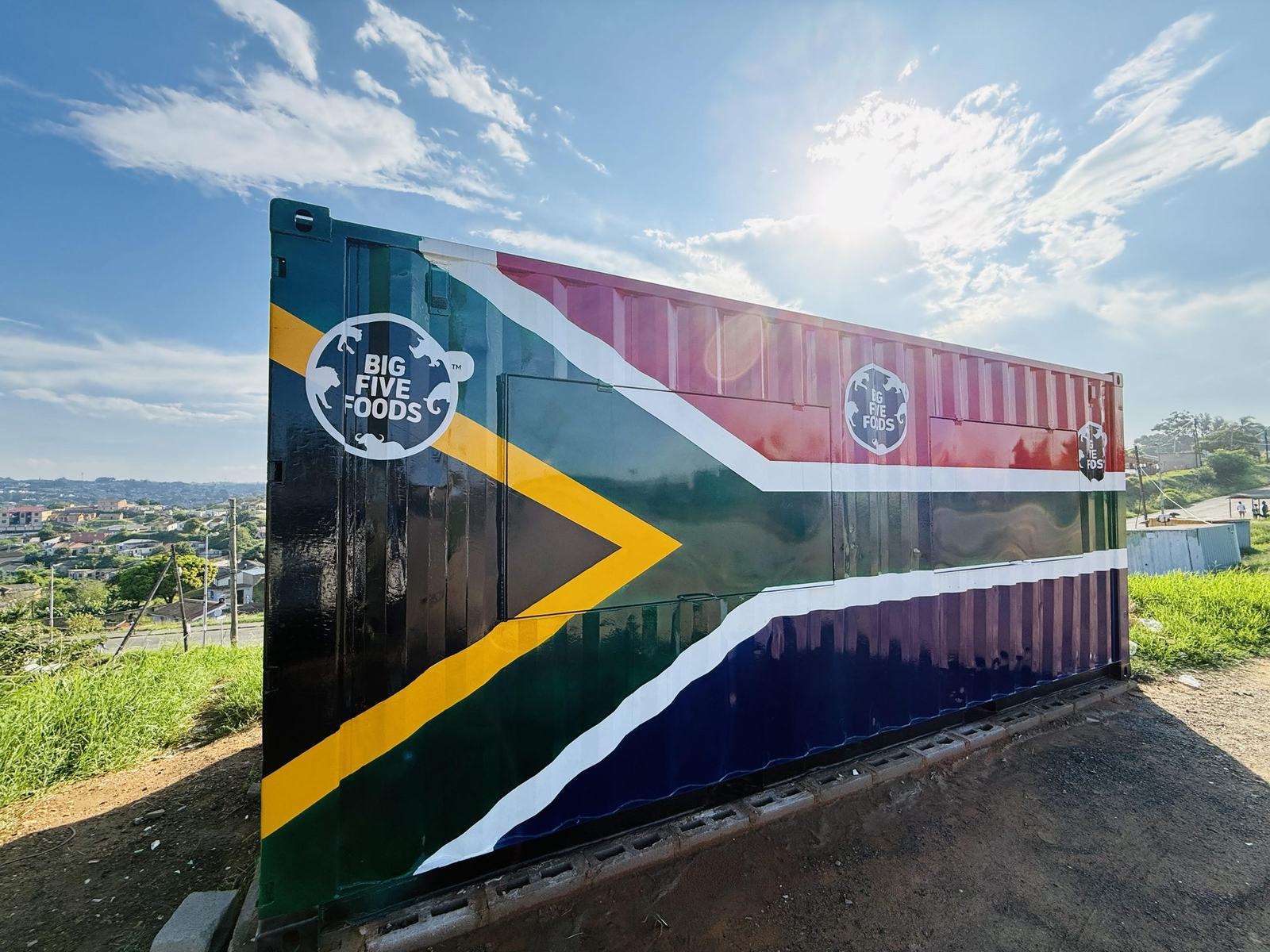
Solar mobile containers at taxi ranks and rural sites, owned and run by youth and women as franchise owners and run on ContainerAdvisor®.

Big Five Connect
Mission · Empower
THE CHALLENGE

Small suppliers struggle to prove they are reliable enough for larger buyers.

OUR RESPONSE

SupplierAdvisor®: a verified trade system for suppliers, products, quotes and orders that buyers and funders can inspect.

Big Five Access
Mission · Empower
THE CHALLENGE

Capital rarely reaches township and rural enterprises on workable terms.

OUR RESPONSE

Pathways to institutional and development finance for projects and the enterprises that deliver them.

Big Five Impact
Mission · Empower
THE CHALLENGE

Programmes stall without delivery discipline and honest reporting.

OUR RESPONSE

Programme management that keeps projects on plan and reports outcomes the same way to every partner.

Big Five Global
Mission · Empower
THE CHALLENGE

African producers need markets beyond their own town and country.

OUR RESPONSE

Ethical routes to market across African and international corridors.

Big Five Royal
Mission · Empower
THE CHALLENGE

Rural communities are often last to benefit from new enterprise.

OUR RESPONSE

A partnership in progress with the Zulu Royal Household, proposing community enterprise from local farmers to local tables.

IN PRACTICE

Ways to act on it today

Deploy a container, become a franchise owner, or bring the Super-Cube® to your team.

How we speak about this work

  • Stats SA, ILO, AfDB and government numbers are external context, never presented as Big Five KPIs.
  • Each figure is quoted exactly as published, with its reference period. The labour figures are updated when Stats SA releases the next quarter.
  • A container application is not a signed deployment, and jobs are counted only when an outlet is open and staffed.
  • We prefer ownership, rails and leadership over one-off charity: dignity with commercial discipline.

Full transparency notes: Methodology & sources. Sister pages: Food security and Quality education.

NGOs & NPOs

How we support NGOs and NPOs that empower communities

Organisations whose work includes empowering projects can list themselves with Big Five Foods in the same public directory, be verified, and receive support through gifts and meals allocated to their projects.

  • Listed in the directory

    Once an organisation is reviewed and approved, and opts in, it appears on the NGOs & NPOs page with its own organisation page.

  • Donors can choose them

    In the donor flow, a listed organisation can be chosen as the recipient of a gift, so the meals go to its projects.

  • Meals allocated to their projects

    Customers and partners can allocate food they buy to an organisation they support. Those meals are counted on the organisation's projects.

  • Verification, project pages and reports

    Organisations can be verified, list their projects publicly, and follow the meals and reports on those project pages.

Build economic empowerment with us

Whether you want to own a container, fund one, supply into programmes or build leaders, we design enterprise that people own, with transparent rails.

WHERE NEXT

Keep exploring

How can we help?